A new Bible Stories app presents the most well-known accounts of Scripture in a creative, visual, and chronological way. Just as the spread of the audio Bible has impacted many communities around the world, digital tools like this can help more people become familiar with the message of God’s Word.
In a world where mobile applications have become essential tools for reading, learning, and communication, it is encouraging to see resources that seek to bring people closer to the stories of the Bible. This new application presents biblical accounts through images and organizes them in chronological order, helping users follow the events of Scripture as they unfolded over time.
Many people want to read the Bible but do not always know where to begin. Some open the Scriptures and feel overwhelmed by the number of books, names, events, genealogies, prophecies, and historical details. Others may have heard certain stories since childhood but have never understood how those stories connect to the larger message of redemption. An app like this can serve as a helpful introduction, especially for those who learn better through visual and organized content.
A creative way to explore Bible stories
The application is designed to tell Bible stories creatively through images and simple reading. This makes it useful for children, young people, new believers, families, and anyone who wants to become more familiar with the great events of Scripture. The visual approach helps users imagine the scenes more clearly, while the chronological order gives a better sense of progression.
In the description of the app we find this invitation:
Go on a journey through the most well-known stories of the Bible with this application designed for an enjoyable and enriching reading experience.
This description summarizes the heart of the project. The goal is not merely to entertain, but to provide a reading experience that is enjoyable, accessible, and spiritually enriching. When biblical stories are presented clearly and respectfully, they can awaken curiosity, encourage further study, and help people see the beauty of God’s Word.
Of course, no app should ever replace the Bible itself. Scripture remains the inspired Word of God and the final authority for faith and life. However, tools like this can help readers approach the Bible with more interest and understanding. They can serve as a bridge, especially for those who are just beginning their journey through the biblical narrative.
Why chronological order matters
One of the strongest features of this application is that it presents the stories in chronological order. This means that the events are arranged according to the order in which they occurred over time. For many readers, this is extremely helpful because the Bible is not always read in a straight historical sequence when approached from Genesis to Revelation.
The Bible contains history, poetry, wisdom literature, prophecy, Gospels, letters, and apocalyptic writing. Because of this, someone who is new to Scripture may find it difficult to understand how all the books connect. Chronological organization can help the reader see the flow of biblical history more clearly: creation, the fall, the patriarchs, the Exodus, the kingdom of Israel, the prophets, the life of Jesus, the early church, and the hope of final restoration.
This kind of structure is especially valuable for beginners. Instead of feeling lost between different books and timelines, the user can follow a guided path. The stories become connected. The reader begins to see that the Bible is not a collection of disconnected accounts, but one great story centered on God’s purpose, His promises, His faithfulness, and ultimately the redemption found in Christ.
Chronological reading also helps families and teachers. A parent explaining Scripture to a child can use the order of events to show how one story leads to another. A teacher can use the app as a visual support for lessons. A new believer can use it as a simple way to understand the general timeline of the Bible before going deeper into personal study.
Images that help readers understand Scripture
Another important strength of this app is the use of images. Visual learning can be very effective, especially when dealing with stories, places, characters, and events that may feel distant from modern life. Images can help readers imagine the biblical world and remember the main points of each account.
For children, illustrations can make the reading experience more engaging. Many children understand stories more easily when they can see characters and scenes represented visually. A well-designed image can help them remember Noah, Abraham, Moses, David, Daniel, Mary, the apostles, and many other biblical figures.
For adults, images can also be helpful. Sometimes we read familiar stories so quickly that we fail to slow down and consider their meaning. A visual presentation can invite the reader to pause, observe, and reflect. It can make the story feel more immediate and help the heart connect with the message.
However, it is always important to use visual resources wisely. Images should support the biblical text, not replace it. They should help readers engage with Scripture while encouraging them to return to the Bible itself. The best Christian educational tools are those that create a hunger for God’s Word rather than distracting from it.
A useful resource for families
This application can be a valuable resource for families that want to introduce children to the stories of the Bible. Many parents desire to teach Scripture at home but do not always know how to make Bible reading simple and understandable for younger children. A visual and chronological app can help make family devotion more accessible.
Parents can use the app before bedtime, during family worship, or as part of a weekly Bible reading routine. After reading a story, they can ask simple questions: What did we learn about God? What did this person do? What does this story teach us about faith, obedience, sin, forgiveness, or trust? These questions can turn a short reading into a meaningful spiritual conversation.
The app can also help children understand that the Bible is not merely a book of isolated moral lessons. It is the story of God’s dealings with humanity. It shows creation, rebellion, judgment, mercy, promises, sacrifice, covenant, redemption, and hope. When children begin to see this larger story, they can understand the Bible with greater depth as they grow.
In a generation where children are surrounded by screens, it is wise for Christian families to look for tools that can turn technology toward spiritual formation. Not every screen moment has to be empty or harmful. When used carefully, digital resources can support teaching, conversation, and biblical understanding.
Helpful for Sunday school and Bible classes
Beyond the home, this app may also be useful for Sunday school teachers, youth leaders, and Bible class instructors. Visual resources can help students follow the lesson more easily, especially when the story includes unfamiliar places, names, or historical settings.
A teacher can use the chronological structure to explain where a story fits within the larger biblical timeline. For example, the story of Joseph can be connected to the later Exodus. The story of David can be connected to the promises about the Messiah. The story of the prophets can be connected to the coming of Christ. This helps students understand Scripture as a unified whole.
This is particularly important because many people know individual Bible stories but do not understand how they connect. They may know about Noah’s ark, David and Goliath, Daniel in the lions’ den, and the birth of Jesus, but they may not understand how these stories fit within the unfolding plan of God. A chronological Bible story app can help fill that gap.
Teachers should still encourage students to open the Bible directly. The app can introduce or reinforce the story, but Scripture should remain central. The best use of a tool like this is to support Bible reading, not to replace it.
Technology as a tool for biblical learning
Technology has changed the way people read, study, and share information. Many believers now use Bible apps, reading plans, devotionals, podcasts, videos, and digital libraries. These tools can be a blessing when used with wisdom. They allow people to access Scripture and Christian teaching from almost anywhere.
At the same time, technology must be used carefully. A phone can help us read the Bible, but it can also distract us from prayer. An app can teach us biblical stories, but it can also become just another piece of content consumed quickly and forgotten. The tool itself is not enough; the heart must be intentional.
This is why Christians should approach digital resources with discernment. We should ask whether a tool helps us understand God’s Word better, encourages reverence, supports sound teaching, and leads us toward deeper faith. If it does, then it can be received with gratitude and used wisely.
This is also why reflections on the relationship between technology and faith are useful. For example, this reflection on iOS 26 and the Bible shows how even modern technological developments can lead us to think about spiritual lessons, wisdom, and the Christian life.
The importance of learning Bible stories well
Bible stories are not merely children’s tales. They are inspired accounts that reveal the character of God, the condition of humanity, the seriousness of sin, the need for redemption, and the faithfulness of the Lord. When we read them carefully, we discover that they teach much more than basic morality.
The story of creation teaches us that God is the Creator of all things. The fall teaches us about sin and separation from God. The flood teaches us about judgment and mercy. Abraham teaches us about faith and promise. Joseph teaches us about providence. Moses teaches us about deliverance. David teaches us about worship, kingship, weakness, and repentance.
The prophets teach us about God’s holiness and the call to repentance. The Gospels teach us about the life, death, and resurrection of Jesus Christ. Acts teaches us about the growth of the early church. The letters teach us doctrine and Christian living. Revelation reminds us of the final victory of God.
When Bible stories are understood in this larger context, they become powerful tools for discipleship. They shape how we see God, ourselves, the world, and the gospel. That is why a chronological app can be useful: it helps readers see that every story has a place in the great narrative of Scripture.
A tool that can awaken interest in Scripture
Some people may begin with an app like this because they are curious, not yet deeply committed to Bible study. That is not necessarily a bad thing. Curiosity can become the first step toward deeper engagement with Scripture. A simple visual story can awaken questions: Who is God? Why did this happen? What does this mean? How does this connect to Jesus?
The goal should always be to move from curiosity to understanding, and from understanding to faith and obedience. A Bible story app can open the door, but the reader should be encouraged to continue into the biblical text itself. The more we read Scripture, the more we see its depth, unity, and authority.
This is especially important for young people. Many children and teenagers are used to learning through images, short explanations, and interactive formats. If a Christian app can capture their attention and lead them toward Scripture, it can become a useful resource in their spiritual formation.
Adults can also benefit. Some adults grew up hearing Bible stories but never studied them carefully. Others are returning to faith after years away. Others are new believers who want a simple starting point. For all these groups, a visual and chronological journey can provide clarity and encouragement.
Biblical storytelling and Christian media
The rise of Christian apps, films, series, and visual resources shows that many people are looking for ways to engage with the Bible through media. This can be positive when the content is handled with respect, accuracy, and reverence. Visual storytelling can help people imagine biblical events and become more interested in Scripture.
However, Christian media should always be evaluated by the Bible. No adaptation is perfect. Whether it is an app, a film, a series, or an illustrated story, the viewer or reader must remember that the Bible itself is the standard. Creative presentation can be useful, but it must not become more authoritative than Scripture.
This balance is important when watching or using any biblical content. We can appreciate the creativity, effort, and educational value of a project while still comparing it with the biblical text. This helps us receive what is helpful and reject anything that may be confusing or inaccurate.
Other Christian media can also encourage people to revisit Scripture. For example, this Christian series about the apostle Paul reminds us how visual productions can awaken interest in biblical figures and lead viewers back to the book of Acts and the New Testament letters.
A simple design that makes reading easier
One of the advantages of a Bible story app is simplicity. Many people are more likely to continue reading when the content is presented clearly. A clean design, organized sections, and visual support can help users stay focused and avoid feeling overwhelmed.
This is especially helpful for those who may not be used to long reading sessions. Short story sections can introduce important biblical events without demanding too much at once. Over time, this can build confidence and interest. A person who begins with short Bible stories may eventually desire to read entire chapters and books of the Bible.
The visual format also makes the app easier to use in different settings. A parent can sit with a child and read one story. A teacher can show an image while explaining a lesson. A new believer can follow the sequence alone. The simplicity of the format allows it to serve different needs.
Good design matters because it can remove unnecessary obstacles. When a tool is confusing, people may stop using it. But when it is clear and inviting, users are more likely to continue. In that sense, design can serve the purpose of biblical education.
Why biblical content must remain faithful
Whenever Bible stories are summarized or illustrated, faithfulness becomes very important. A short version of a biblical story should not distort the message. It may simplify details, but it should not change the meaning. The goal is to help people understand Scripture, not to replace it with personal imagination.
This is especially important for children. The way children first hear Bible stories can shape their understanding for years. If stories are presented only as moral tales, children may miss the larger message of God’s holiness, human sin, grace, covenant, and redemption. If stories are presented faithfully, they can help build a strong foundation.
For example, David and Goliath is not merely a lesson about being brave. It is also about God’s power to deliver His people. Noah’s ark is not merely about animals and a boat. It is about judgment, mercy, and covenant. The story of Jesus calming the storm is not merely about feeling peaceful. It reveals His authority over creation.
A good Bible story app should help users see these truths, even in a simple way. The images may attract attention, but the message must remain centered on what Scripture teaches.
Using the app for personal growth
If you decide to use this app, it may be helpful to approach it with a devotional mindset. Do not only scroll through the stories quickly. Take time to read, observe, and think. Ask what the story reveals about God. Ask what it reveals about human nature. Ask how it points to Christ or prepares the way for the gospel.
You can also use the app alongside your Bible. After reading a story in the app, open the biblical passage and read the full account. This will help you go deeper and compare the summary with Scripture. It will also train you to see the app as a guide, not as the final source.
For families, one good practice is to read one story at a time and then pray together. The prayer does not have to be long. It can be simple: thanking God for His Word, asking for understanding, and asking for grace to obey Him. This turns reading into worship and reflection.
For teachers, the app can serve as an introduction to a lesson. Show the image, read the summary, then open the Bible and explain the text more fully. This can help students connect visual memory with biblical truth.
Encouraging children to love the Bible
One of the greatest responsibilities of Christian parents and teachers is to help children know and love the Bible. This does not happen automatically. Children need patient instruction, repeated exposure, clear explanations, and examples of adults who value Scripture.
A Bible story app can help by making the first steps enjoyable. Beautiful images and clear stories can capture attention, but adults must help children understand why these stories matter. The goal is not merely that children know names and events, but that they begin to see the greatness of God.
Children should learn that the Bible is not a fantasy book. It is not merely a collection of inspirational stories. It is God’s Word. It tells us who God is, what He has done, what He commands, and how He saves sinners through Jesus Christ.
When children grow with this understanding, Bible stories become more than entertainment. They become seeds of truth planted in the heart. Over time, by God’s grace, those seeds can bear fruit in faith, repentance, worship, and obedience.
Bible stories and the call to worship
Every true encounter with Scripture should lead us toward worship. When we read of creation, we worship God as Creator. When we read of deliverance, we worship Him as Savior. When we read of judgment, we tremble before His holiness. When we read of mercy, we rejoice in His grace. When we read of Christ, we behold the fullness of God’s redemptive plan.
This is why Bible stories should not be treated as mere information. They should move the heart. They should teach us to trust, obey, repent, give thanks, and worship. The more we understand Scripture, the more reasons we find to praise the Lord.
This connects with the broader truth that believers were created to worship God. Resources such as this reflection on seven reasons to worship God remind us that all biblical learning should eventually lead to reverence, gratitude, and praise.
If a Bible story app helps a person admire God more, understand Scripture better, and desire to read the Bible more faithfully, then it can be a useful tool. The value is not only in the technology, but in how that technology points the heart back to the Lord.
Download the Bible Stories app
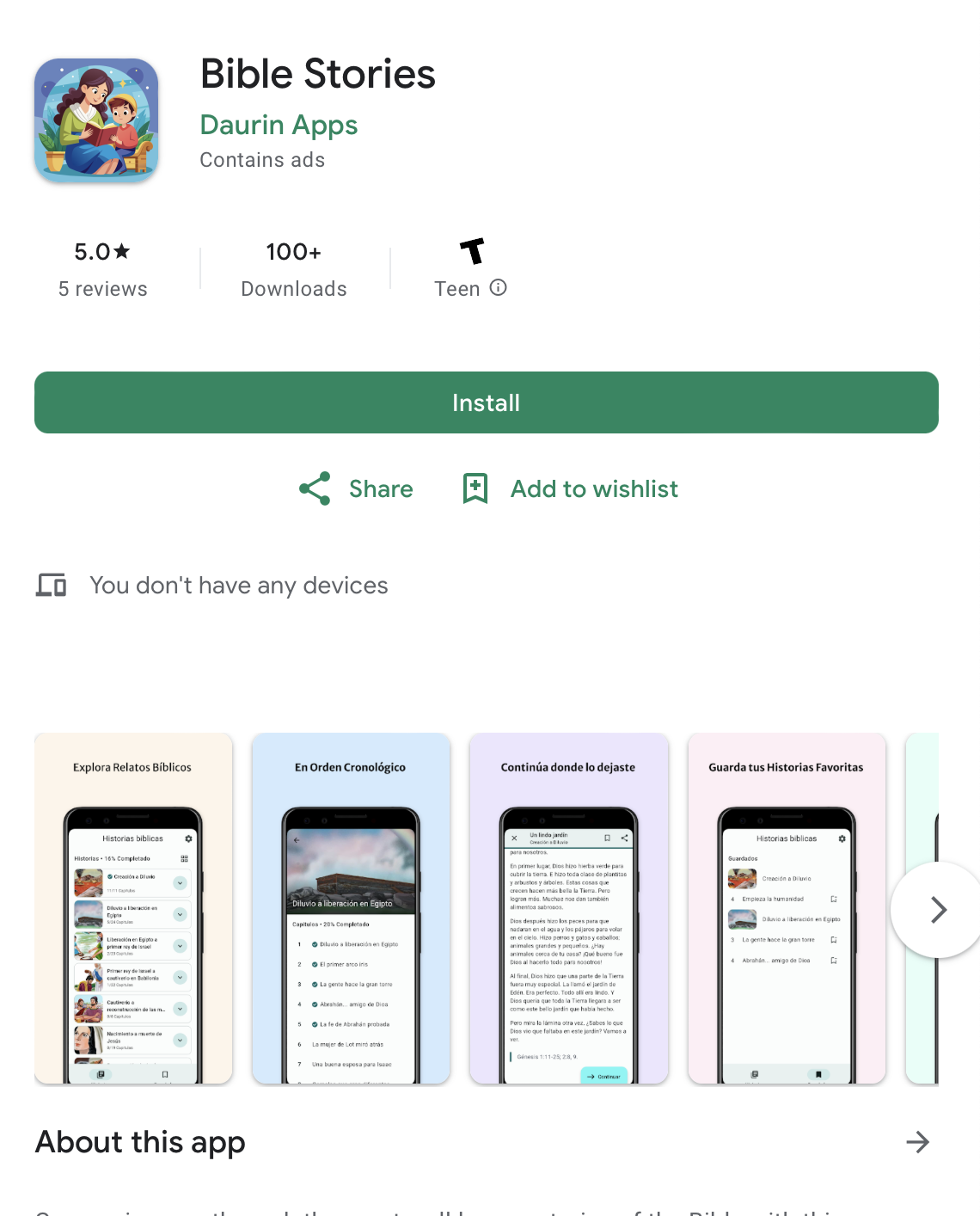
You can download this application through Google Play. Its purpose is to help users journey through the most well-known stories of the Bible in a simple, creative, and visually engaging way. For those who enjoy learning through images, this app may become a helpful companion.
If you are a parent, teacher, Sunday school leader, or simply someone who wants to understand the biblical story more clearly, this resource may be worth exploring. It can be used for personal reading, family devotion, classroom support, or introductory Bible learning.
You can access the application by clicking on the following image:
Conclusion
This Bible Stories app is a practical and creative tool for anyone who wants to explore the accounts of Scripture in a more visual and organized way. Its chronological structure can help readers understand how the events of the Bible unfold over time, while its images can make the stories easier to remember and discuss.
For children, it can be an engaging introduction to the Bible. For parents, it can support family devotion. For teachers, it can provide visual help in lessons. For new readers, it can make the biblical narrative feel less overwhelming. Used wisely, it can become a bridge toward deeper study of God’s Word.
Still, we must remember that every Christian resource should lead us back to Scripture itself. The app can help, illustrate, organize, and introduce, but the Bible remains the final and highest authority. Let every tool we use increase our love for the Word of God, not replace it.
If you are looking for a simple and creative way to learn more about the stories of the Bible or to help others understand them better, this application is an excellent alternative. May it encourage many people to begin a visual and chronological journey through the biblical accounts that have shaped faith, worship, and hope for generations.