MrBeast is one of the most influential creators in the world, but many people still remember that his early YouTube channel showed clear Christian references. This topic invites us to think carefully about faith, fame, public identity, and the importance of remaining firm in Christ, just as believers are reminded in praising God because He is God, and not for His benefits.
Many people who watched the MrBeast channel when he was not yet famous claim that the well-known YouTuber openly showed signs of being a Christian in his early years. This belief did not appear out of nowhere. Some of his old channel banners reportedly included Christian symbols, biblical references, and phrases connected to the gospel. For those who followed him before the millions of subscribers, before the enormous giveaways, before the massive humanitarian projects, and before the global fame, these details seemed to reveal something sincere about his early convictions.
Let’s take a look at some of those old banner images that have circulated online and have been discussed by users who remember the early stages of his channel:








As you may have noticed, MrBeast’s old banner designs included the cross symbol, the verse John 3:16, and the phrase “I am not ashamed of the gospel of Christ.” For many Christians, that phrase is not small or casual. It comes from the language of Romans 1:16, where the apostle Paul declares that he is not ashamed of the gospel, because it is the power of God unto salvation. To use that kind of phrase publicly, especially on a YouTube banner, gives the impression that the person wanted others to associate his channel with Christian belief.
If that were not enough, some old comments attributed to MrBeast seem to strengthen the idea that he openly identified with Christianity at that time. Let’s see:
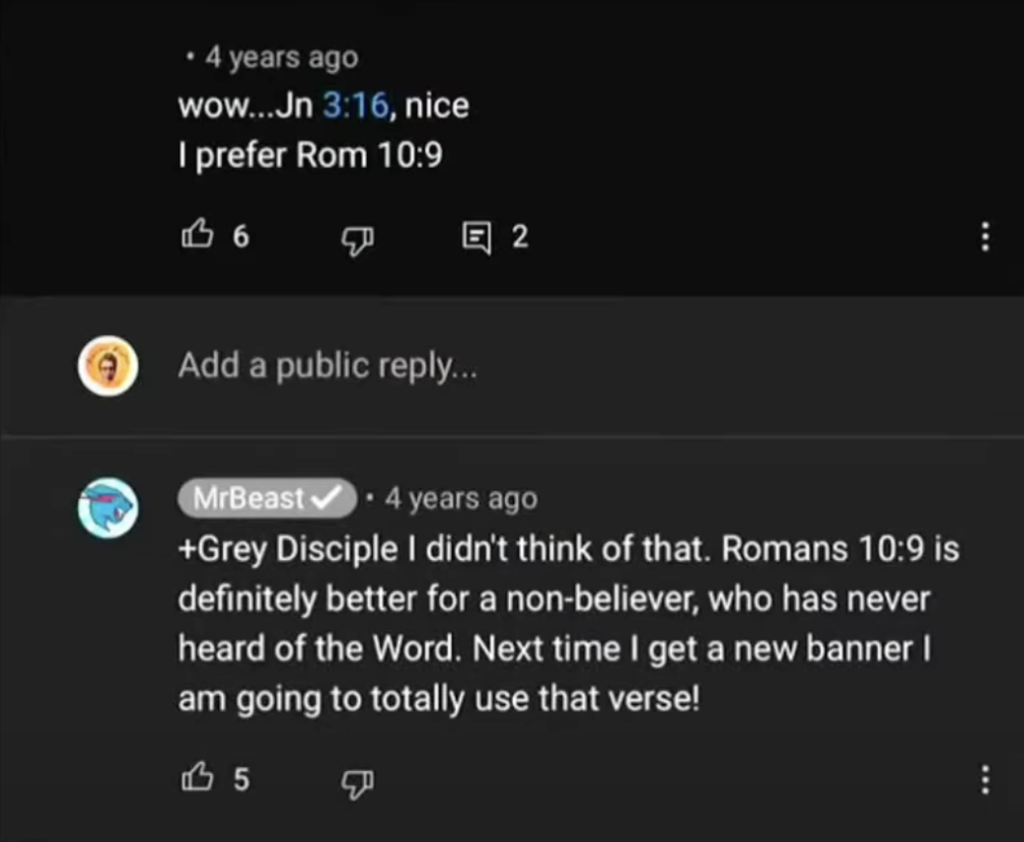
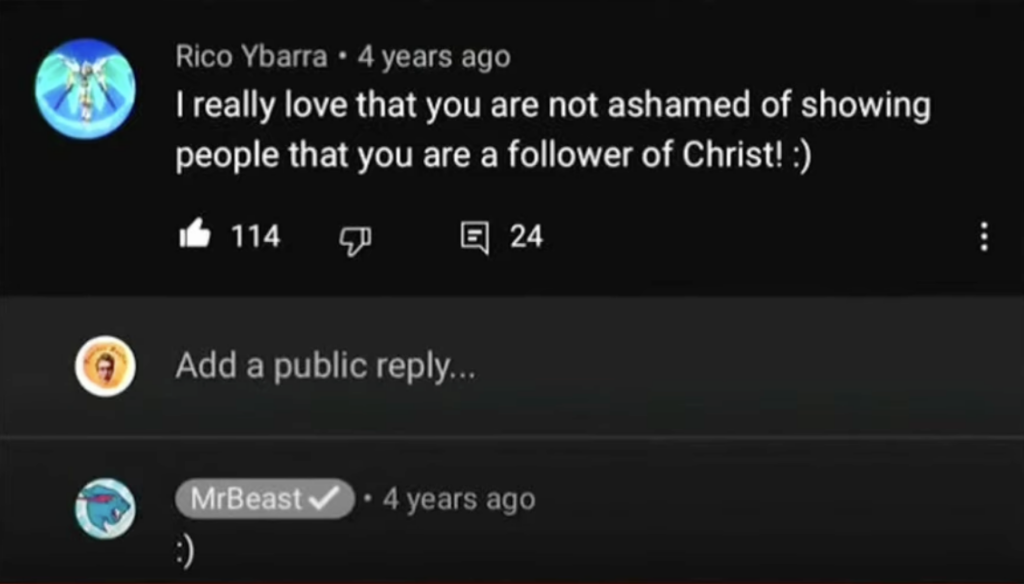
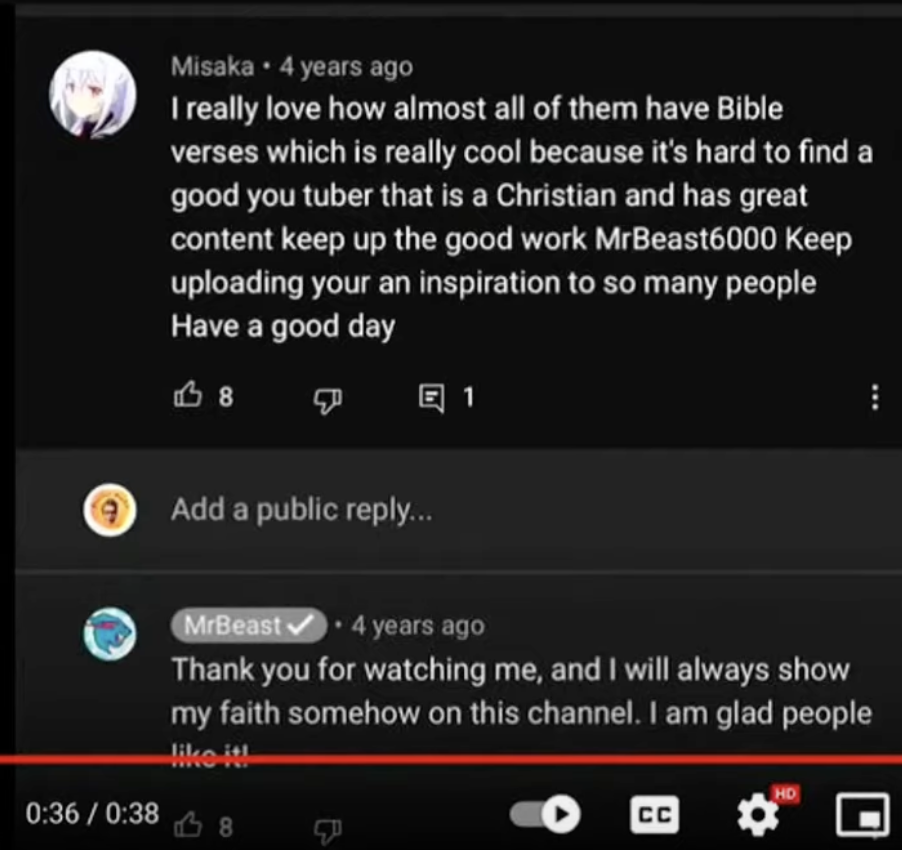
In the first image above, someone suggests the verse Romans 10:9, and MrBeast reportedly thinks it is a good idea and says he would use that verse in a future banner. In the second image, someone expresses happiness at having found a Christian YouTuber, and MrBeast apparently replies that he will always look for a way to share his faith on the channel. In the last image, a person says they love MrBeast because he is not ashamed to show people that he is a follower of Christ, and MrBeast responds with a happy face.
Was MrBeast openly Christian in his early years?
Based on those old banners and comments, many people would say, “Yes, he was definitely a Christian.” At the very least, it seems clear that Christian references were present in his early public image. He was not hiding biblical language. He was not afraid to show a cross. He was not avoiding verses. He was not acting as though faith had no place on his channel.
This is what makes the conversation so interesting for many of his followers. MrBeast, whose real name is Jimmy Donaldson, did not begin as the global entertainment figure we know today. He began like many young YouTubers: recording videos, experimenting with content, building a small audience, and trying to find his place online. In that stage, his banners and comments seemed much more personal and spontaneous. They did not look like a carefully calculated corporate brand. They looked like the expression of a young person who wanted to show something he believed.
For many Christian viewers, this was encouraging. It is not common to see young creators openly include Christian language in gaming content, challenge videos, or early YouTube branding. Many people who followed him back then felt that they had discovered a creator who was not ashamed of his faith. That detail made his early story especially memorable.
However, the story did not remain there. MrBeast grew rapidly. His channel became one of the largest platforms in the world. His content moved from simple videos to massive productions, high-budget challenges, charitable acts, global campaigns, and projects that reach millions of people. With that growth came a different public image, a different level of pressure, and a much broader audience.
What he said when Logan Paul asked him
Years later, in 2019, Logan Paul directly asked MrBeast about his faith. This moment surprised many people who remembered the old banners and Christian references. Instead of giving the kind of answer his early followers might have expected, he described himself as someone closer to agnosticism. In other words, he no longer seemed to express the same certainty that appeared in his earlier channel identity.
Video reference: Logan Paul asked him directly about this topic in 2019.
This answer created many questions. What happened? Did his beliefs genuinely change? Did fame influence the way he spoke publicly about faith? Did he go through a season of doubt? Was he trying to avoid controversy in front of a massive and diverse audience? Or was he simply being honest about the place where he found himself spiritually at that moment?
These are not easy questions to answer from the outside. We should be careful not to pretend that we know everything happening inside another person’s heart. Only God knows the heart perfectly. But it is understandable that people are curious, because the contrast between his early Christian references and his later agnostic statements is significant.
For some viewers, the change felt disappointing. They remembered a young creator who seemed bold about sharing Christian faith, and now they saw a global figure speaking much more cautiously or uncertainly. For others, the change seemed like part of the normal process many young people experience as they grow, question things, and rethink what they were taught. Either way, the discussion continues because MrBeast is not an ordinary creator. He is one of the most visible media personalities in the world.
Fame can change how people speak about faith
One of the most important things to consider is the weight of fame. It is one thing for a young creator with a small audience to place a Bible verse on a banner. It is another thing to speak about Christianity when millions of people from many different cultures, religions, ideologies, and backgrounds are watching every word. Fame does not only bring money and opportunity. It also brings pressure.
Today, every public statement can become a headline, a controversy, a reaction video, a social media debate, or a reason for people to attack or defend someone. A creator as large as MrBeast must know that anything he says can be interpreted, clipped, shared, criticized, and discussed by millions. That reality may cause many public figures to become more neutral, more careful, or more silent about personal beliefs.
This does not justify denying Christ, of course. Jesus Himself warned that following Him would involve cost. The Christian faith is not meant to disappear when public pressure increases. At the same time, when we discuss public figures, we must recognize that the entertainment world often rewards neutrality and punishes conviction. The larger the platform, the greater the temptation to avoid any statement that could divide the audience.
This is why fame can become spiritually dangerous. Success can place a person in environments where faith is treated as something private, embarrassing, controversial, or unnecessary. Wealth can give the illusion of self-sufficiency. Global influence can make a person more concerned with brand protection than with biblical clarity. The heart must be guarded carefully, because what begins as caution can slowly become silence.
Was he ashamed of the gospel?
Some people ask a strong question: Is MrBeast now ashamed of the gospel? That question comes naturally because his old banners reportedly said, “I am not ashamed of the gospel of Christ.” When someone once used that phrase publicly and later describes himself as agnostic, people will inevitably wonder what changed.
But we should be careful with accusations. To say with certainty that he is ashamed of the gospel would require knowledge of his heart that we do not possess. What we can say is that his public language appears to have changed. In earlier years, Christian references were visible. Later, his statements became more uncertain. That is enough to raise concern, but not enough to make final judgments about his soul.
The better question for all of us may be this: Would we remain faithful if our platform grew? Would we still speak clearly of Christ if our audience included millions? Would we still identify with the gospel if it cost us popularity, sponsorships, followers, or cultural approval? It is easy to analyze someone else’s spiritual journey. It is harder to examine our own courage.
Every believer should ask God for grace to remain faithful in public and in private. The pressure to hide faith does not only come to celebrities. It also comes to students, workers, professionals, content creators, business owners, and even families. The world does not always persecute faith with violence; sometimes it simply pressures believers to be quiet, vague, or embarrassed.
Good works are not the same as saving faith
Another part of the conversation is MrBeast’s charitable work. Many people admire him because he has helped the blind see, supported people in need, built wells, given away homes, paid for surgeries, planted trees, and used his platform for large acts of generosity. These actions have impacted millions and should not be ignored. They show that his content has often gone beyond entertainment into humanitarian projects.
Some people argue that these good works reflect Christian values, even if he does not currently identify clearly as a Christian. There may be some truth in the sense that generosity, compassion, and helping the poor are consistent with biblical ethics. Christians should appreciate acts of mercy wherever they appear. It is better to help people than to exploit them. It is better to feed the hungry than to ignore them. It is better to use money to relieve suffering than to waste it only on vanity.
However, from a biblical perspective, good works are not the same thing as saving faith. A person can do generous things and still not confess Christ as Lord. A person can help the poor and still remain spiritually uncertain. A person can perform public acts of kindness and still need the gospel. Christianity does not teach that we are saved by philanthropy, fame, or humanitarian impact. We are saved by grace through faith in Jesus Christ.
This distinction matters because modern culture often confuses kindness with conversion. If someone does good things, people quickly assume that he must be spiritually right. But the Bible teaches that the central question is not merely, “Has this person done good works?” The central question is, “Does this person belong to Christ?” Good works matter, but they cannot replace repentance and faith.
A reminder about public faith and private conviction
The story of MrBeast also reminds us that public signs of Christianity should be accompanied by deep personal conviction. A cross on a banner, a Bible verse in a profile, or a Christian phrase in a comment can be meaningful, but they are not enough by themselves. True faith must be rooted in Christ, nourished by Scripture, strengthened by prayer, and lived out in obedience.
There are many people who grow up around Christianity, use Christian language, like Christian symbols, or respect Christian values, but later discover that their faith was not deeply grounded. When pressure comes, when questions arise, when fame increases, when suffering arrives, or when the world offers another path, they begin to drift. This is why discipleship matters so much.
A young believer needs more than emotional enthusiasm. He needs doctrine. He needs the Word of God. He needs a local church. He needs older believers who can guide him. He needs spiritual discipline. He needs to understand why he believes, not only what he believes. Without roots, public faith can fade quickly.
This is also why the spread of Scripture remains so important in every generation. The Christian life is not sustained by public image, but by the truth of God’s Word. In that sense, resources that help people hear and meditate on Scripture, like the reflection on the great impact of the audio Bible on the world, remind us that faith must be fed continually by the voice of God through Scripture.
The danger of building faith on famous people
There is another lesson here for Christian audiences: we must not build our faith on celebrities. Many believers become excited when a famous person says something positive about Christianity. They immediately celebrate, share clips, and treat the person as an example of faith. Sometimes that joy is understandable, but it can also become dangerous if we are not discerning.
Famous people are still people. They can change. They can struggle. They can be confused. They can be immature. They can say things today and say different things tomorrow. They can be sincere at one stage and uncertain at another. If our confidence depends on whether a celebrity identifies as Christian, then our foundation is weak.
The Church does not need celebrities in order for the gospel to be true. Christ is enough. The apostles did not need cultural approval to preach. The martyrs did not need fame to remain faithful. The truth of Christianity does not rise or fall because a YouTuber, actor, singer, athlete, or businessman affirms it. Jesus Christ is Lord regardless of what public figures say.
This does not mean we should not rejoice when someone with influence follows Christ. Of course we can rejoice. But we must rejoice carefully, pray sincerely, and remember that the fruit of faith is seen over time. Instead of turning famous people into spiritual heroes, we should pray that God would truly save, strengthen, and guide them.
What Christians can learn from this discussion
The debate around MrBeast’s faith should not become mere gossip. It should lead us to examine larger questions about our own lives. Are we firm in what we believe? Are we willing to be identified with Christ? Do we know the gospel deeply enough to stand when doubts come? Are we teaching young believers to build their faith on Scripture rather than emotion?
Many young people today are growing up in a digital world where identity changes quickly. They are influenced by creators, trends, algorithms, comments, debates, and public pressure. One day someone is celebrated for being bold. The next day that same person is mocked for the same conviction. Without biblical grounding, it is easy to adapt to whatever gains approval.
This is why believers must cultivate a faith that is deeper than branding. Christianity is not a style, a banner, a slogan, or a childhood memory. It is union with Christ. It is repentance from sin. It is trust in the Savior. It is a life of discipleship. It is taking up the cross daily and following Him, whether the world approves or not.
At the same time, Christians should respond to people like MrBeast with prayer, not hatred. If he once professed faith and now expresses uncertainty, then the proper response is not mockery. It is prayer that God would reveal Himself, bring clarity, and draw him to Christ. The same God who saves unknown sinners can also save famous sinners. The same grace that reaches ordinary people can reach influencers with millions of followers.
Faith, influence, and responsibility
A person with a large audience carries a great responsibility. Words influence people. Silence influences people. Public identity influences people. When someone like MrBeast speaks about faith, millions may listen. When he avoids the topic, millions may also notice. This is part of the weight that comes with influence.
For Christians who create content, the lesson is clear: do not wait until you are famous to decide whether Christ matters. Decide now. If your platform grows, your convictions should already be rooted. If your audience expands, your faith should not shrink. If your opportunities increase, your dependence on God should increase as well.
The temptation of influence is to become more careful with the brand than with the soul. But no brand is worth losing spiritual clarity. No audience is worth denying the Lord. No sponsorship is worth being ashamed of Christ. Jesus said that whoever is ashamed of Him and His words, of him the Son of Man will also be ashamed. That warning should make every believer tremble and pray for courage.
At the same time, Christian courage must be humble. It is not about using faith as a marketing strategy. It is not about forcing religious language into every public moment. It is about being honest, faithful, and unashamed when the opportunity comes. True Christian witness flows from a heart that belongs to Christ, not from the desire to impress religious audiences.
Why Christ must remain the center
The most important part of this discussion is not MrBeast himself. The most important part is Christ. Human stories change. Public figures rise and fall. People make professions, go through doubts, return, drift, grow, or remain uncertain. But Jesus Christ remains the same yesterday, today, and forever.
The Christian faith is not centered on the spiritual journey of a YouTuber. It is centered on the Son of God who lived a perfect life, died for sinners, rose from the dead, and reigns forever. He is the One to whom every person, famous or unknown, must give account. He is the One who saves. He is the One who is worthy.
That is why worship must always return to Christ. The Church should not be more fascinated by celebrity stories than by the glory of the Savior. The Lamb who was slain is infinitely more worthy of attention than any online personality. This is why reflections such as The Lamb who was slain is worthy of praise help believers recover the right focus: Christ is the center of all true worship.
When Christ is central, we can discuss cultural stories without losing spiritual balance. We can talk about MrBeast without making him the foundation of faith. We can examine the issue without becoming obsessed. We can be thankful for good works while still emphasizing the need for saving faith. We can pray for him while keeping our eyes fixed on the Lord.
The role of sincerity in public worship
Another helpful lesson from this discussion is the importance of sincerity. In the age of social media, many people display symbols, phrases, causes, and identities because they produce reactions. Some things are posted because they are truly believed. Other things are posted because they help build an image. Only God knows the difference perfectly.
This does not mean we should cynically doubt every public expression of faith. But it does mean we should remember that Christian identity must be deeper than appearance. A person can use Christian symbols and still need spiritual maturity. A person can talk about faith and still struggle with doubt. A person can be admired by Christians and still be in process.
The same warning applies to all of us. Our worship must not be performed merely for people to see. Our faith must not be reduced to content, aesthetics, or approval. Jesus warned about religious actions done for human applause. What matters is the heart before God. This is why every believer should consider the question raised in Is your worship for God or for social media?.
If our faith is real only when others praise us, then it is fragile. If our worship depends on public attention, then it is misdirected. If we speak of Christ only when it benefits our image, then our hearts need correction. True worship is for God first, whether people applaud or not.
Conclusion
The story of MrBeast and his early Christian references continues to generate debate because it touches something deeper than curiosity about a celebrity. It raises questions about faith, fame, courage, doubt, public identity, and the pressure that comes with influence. His old banners and comments seemed to show a young creator willing to associate himself with Christianity. His later statements suggested a movement toward agnosticism or uncertainty. That contrast is what keeps the discussion alive.
But Christians should handle this topic with wisdom. We should not pretend to know everything about his heart. We should not turn the discussion into gossip. We should not build our faith on whether he identifies as Christian or not. Instead, we should use the conversation as an opportunity to examine ourselves, pray for those with influence, and remember the importance of being rooted in Christ.
MrBeast’s charitable works may inspire many people, and we can acknowledge the good that has been done through acts of generosity. But from a biblical perspective, good works do not replace the need for repentance, faith, and confession of Christ as Lord. A person can impact the world and still need the Savior. A person can help millions and still need the grace of God.
In the end, the question is not only whether MrBeast was once Christian or whether he is agnostic now. The question for every reader is this: Are we ashamed of the gospel? Are we willing to follow Christ when faith costs us something? Are we rooted deeply enough to stand when pressure comes? Are we worshiping God sincerely, or only using religious language when it is convenient?
May God give us humility, discernment, and courage. May He strengthen those who are doubting. May He save those who are far from Him. May He keep believers from idolizing famous people. And above all, may Christ remain the center of our faith, our worship, and our public witness.