When a member has to decide between staying in a congregation or leaving for another, the music or the entrance of a new preacher are not very important aspects that are taken into account when making that decision. According to multiple surveys and research studies, the majority of Christian people base that decision primarily on doctrine and theology, rather than on stylistic or cultural elements.
This reality challenges many of the assumptions that are often repeated within church leadership circles. In recent years, there has been an intense focus on improving worship bands, updating musical arrangements, and adapting services to contemporary cultural trends. While music is undoubtedly an important element of corporate worship, the data shows that it is not the decisive factor when believers evaluate whether a congregation remains faithful to what they believe the Bible teaches.
In fact, this reveals something deeper about the heart of the believer. While preferences may vary, there is a growing awareness among Christians that the true identity of a church is not defined by its sound, its lighting, or its atmosphere, but by its commitment to biblical truth. This is where real spiritual stability is found.
The Role of Music in the Church
Probably nowadays many people who listen to modern songs want to sing those ancient hymns that were sung years ago. Likewise, if we go back to the old hymns, there will be another group that will want modern worship songs. This constant tension shows that musical preference is largely generational and cultural.
Each generation expresses worship in a way that resonates with its context. What one group considers deeply reverent and spiritually meaningful, another may perceive as distant or unfamiliar. However, these differences do not usually lead to division unless they are elevated above their proper place.
According to LifeWay Research, people will probably not leave their church because of the theme of the “worship style.” This conclusion is extremely important because it places music where it belongs: as a means of worship, not as the foundation of faith.
When music becomes the central identity of a church, it can unintentionally overshadow the teaching of Scripture. Worship then shifts from being God-centered to preference-centered, and this can slowly reshape the priorities of the congregation.
True worship is not defined by instruments, genres, or tempos, but by a heart that is aligned with God. Music is simply the vehicle through which that worship is expressed.
What Really Causes People to Leave a Church?
So, if music is not the main reason why people leave the church, what is it? The survey presented below gives us a clear answer:
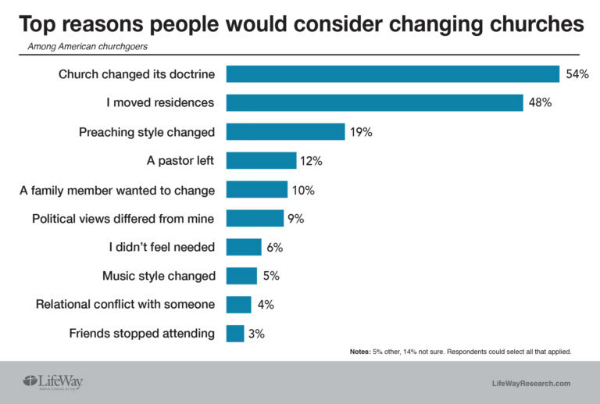
In the survey, respondents were given multiple options and asked to select all that applied as reasons they might change their congregation. These included factors such as: friends leaving the church, personal conflicts, changes in musical style, not feeling needed, political disagreements, family influence, pastoral changes, shifts in preaching style, relocation, and doctrinal changes.
The results are revealing. Only 5 percent said they would leave because of music. This is a surprisingly low number considering how much attention is often given to worship style in modern churches.
Meanwhile, 9 percent indicated that political differences could influence their decision, and 12 percent said they would leave if a pastor left. These factors are more relational and contextual, yet they still do not represent the majority.
The most significant result is that 54 percent of respondents said they would leave their church if there were a change in doctrine. This clearly shows that theology is the primary anchor for many believers.
The Centrality of Doctrine in the Christian Life
Doctrine is not a secondary issue. It is not an optional aspect of the Christian life that can be adjusted according to preference. Doctrine defines how we understand God, salvation, sin, grace, and truth.
When doctrine changes, everything changes. It affects how Scripture is interpreted, how sermons are preached, how believers live, and how the church engages with the world.
This is why many Christians are willing to endure differences in music, leadership styles, or even community dynamics, but are not willing to compromise when it comes to biblical truth.
A church may have excellent music, strong programs, and a vibrant atmosphere, but if its doctrine begins to drift away from Scripture, it loses its foundation. And when the foundation is shaken, everything built upon it becomes unstable.
Theological Conflict in the Modern Church
Certainly, theology plays a very important role in our congregations, and most of the conflicts that we suffer today as a church are due to theological issues that never seem to end.
Differences in biblical interpretation can lead to deep divisions. Issues such as the authority of Scripture, the nature of salvation, the role of the church, and moral teachings are not minor disagreements. They shape the identity and direction of a congregation.
When these differences are not addressed carefully and biblically, they can create tension, confusion, and even fragmentation within the church.
This is why sound doctrine is essential. It provides clarity, unity, and direction. It helps believers navigate difficult questions and remain grounded in truth.
Why Doctrine Has a Lasting Impact
Theology tends to have a much deeper and lasting impact on people than music. While musical styles change over time, doctrine remains the same because it is rooted in the unchanging Word of God.
Music can inspire emotions, but doctrine shapes convictions. Music can move the heart, but doctrine transforms the mind. And ultimately, it is the transformation of the mind that leads to a transformed life.
This is why believers who are serious about their faith will prioritize biblical teaching over personal preferences. They understand that their spiritual growth depends on truth, not on style.
A church that is faithful in teaching Scripture provides stability in a world that is constantly changing. It equips believers to stand firm, discern truth from error, and live according to God’s will.
The Balance Between Doctrine and Community
While doctrine is central, it is also important to recognize the role of community. Relationships, fellowship, and mutual support are essential aspects of church life.
However, community without truth is fragile. A strong sense of belonging cannot replace the need for sound teaching. In fact, true biblical community is built upon shared convictions and a common understanding of God’s Word.
This is why doctrine and community must go hand in hand. When both are present, the church becomes a place of growth, encouragement, and spiritual maturity.
Conclusion: What Truly Defines a Church?
So, what truly defines a church? Is it the music, the atmosphere, or the personalities involved? The answer, as the data clearly shows, is doctrine.
Music may attract people, but doctrine sustains them. Style may engage attention, but truth transforms lives.
This does not mean that music or leadership are unimportant. They play valuable roles in the life of the church. However, they must always remain secondary to the teaching of Scripture.
As believers, we are called to seek churches that are faithful to God’s Word, that prioritize truth over trends, and that are committed to sound doctrine.
So, let us know in the comments for which of these causes selected in the survey you would change your congregation, and why doctrine, community, and biblical teaching matter so deeply in your decision.
Because in the end, the strength of a church is not found in what it looks like on the outside, but in the truth that sustains it from within.