When a member has to decide between staying in a congregation or leaving for another, the music or the entrance of a new preacher are not very important aspects that are taken into account when making that decision, since, according to a survey, the majority of Christian people base that decision on doctrine or theology.
This reality challenges many of the assumptions that are often repeated within church leadership circles. In recent years, there has been an intense focus on improving worship bands, updating musical arrangements, and adapting services to contemporary cultural trends. While music is undoubtedly an important element of corporate worship, the data shows that it is not the decisive factor when believers evaluate whether a congregation remains faithful to what they believe the Bible teaches.
Probably nowadays many people who listen to modern songs want to sing those ancient hymns that used to sing years ago; likewise, if we go back to the old hymns there will be another group that will want the modern hymns. Musical preferences are often generational and cultural, and they naturally change over time. What one group considers reverent and meaningful, another may consider outdated or unfamiliar. These differences, however, do not usually lead to church division on their own.
According to LifeWay Research, people probably will not leave their church because of the theme of the “worship style.” This conclusion is important because it places worship music in its proper place: as a vehicle for praise, not as the foundation of faith. When music becomes the center of church identity, it risks overshadowing the teaching of Scripture and the shared convictions that truly unite believers.
So, if music is not the main reason why people leave the church, what is it? We leave the following survey that determines why most people change congregations.
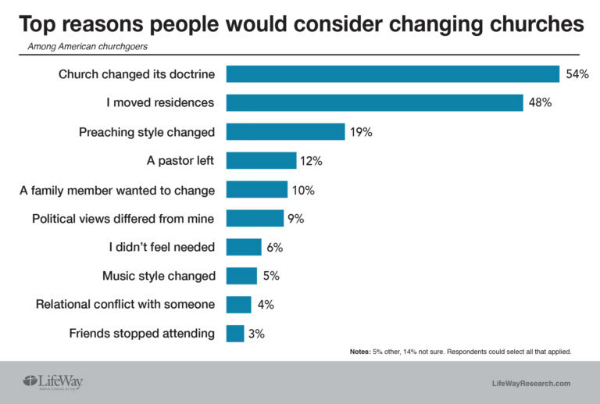
In the survey, respondents were presented with different options to select all that apply as reasons they would change their congregation. The points presented were: friends who stopped attending the church, conflicts with someone, change in musical style, not feeling needed, differences in political views, a family member wanting to change churches, a pastor who left, a change in preaching style, moving to a new residence, and a change of doctrine in the church.
The results are very revealing. Only five percent would leave their current congregation because of the subject of music; nine percent would do so for not agreeing with the political views of the church; and 12 percent if a pastor leaves. These numbers show that, while personal relationships and leadership changes matter, they are still secondary factors for most believers when making such an important decision.
However, the majority—54 percent—would change their congregation if the church they attend changes its doctrine. This clearly highlights how central theology is to the Christian life. Doctrine shapes how we understand God, salvation, Scripture, and daily Christian living. When doctrine shifts, many believers feel that the spiritual foundation of their congregation has been altered.
Certainly, theology plays a very important role in our congregations, and most of the conflicts that we suffer today as a church are due to theological issues that never seem to end. Differences in biblical interpretation, ethical positions, and doctrinal emphasis can deeply affect unity, trust, and spiritual growth within a community.
Theology tends to have a lasting impact on people, unlike music, which often reflects taste and culture. While songs may change from generation to generation, sound doctrine provides stability, clarity, and direction. It helps believers discern truth, remain grounded in Scripture, and grow in their faith even amid cultural shifts.
So, let us know in the comments for which of these causes selected in the survey you would change your congregation, and why doctrine, community, and biblical teaching matter so deeply in your decision.